LEARNING
FRONTIER
OCEAN EXPLORER
Follow the current
THE SURFACE

A world beneath
our world.

From the largest travelers to the smallest drifters.
One extraordinary ocean. All the way down.

Ages 10+ · No prior knowledge · 10–15 minutes
Scroll into the blue
Artist’s interpretationScroll to descend. Tap a discovery to look closer.
20 M / SHALLOW REEFS

A thousand lives.
One living city.

Sunlight spills across a reef built by tiny animals.
Look closer. Almost every surface is alive.

Reef environment: artist’s interpretationAn imagined reef, inspired by tropical biodiversity.
60 M / CHANGE YOUR SCALE

A drop of ocean.
A universe of life.

Pause the descent. Change your sense of scale.
There is an extraordinary world hiding in the water.

Magnified artistic montage · not to scaleSwitch between the imagined overview and real specimen images.
800 M / THE TWILIGHT ZONE

The light fades.
Life surprises.

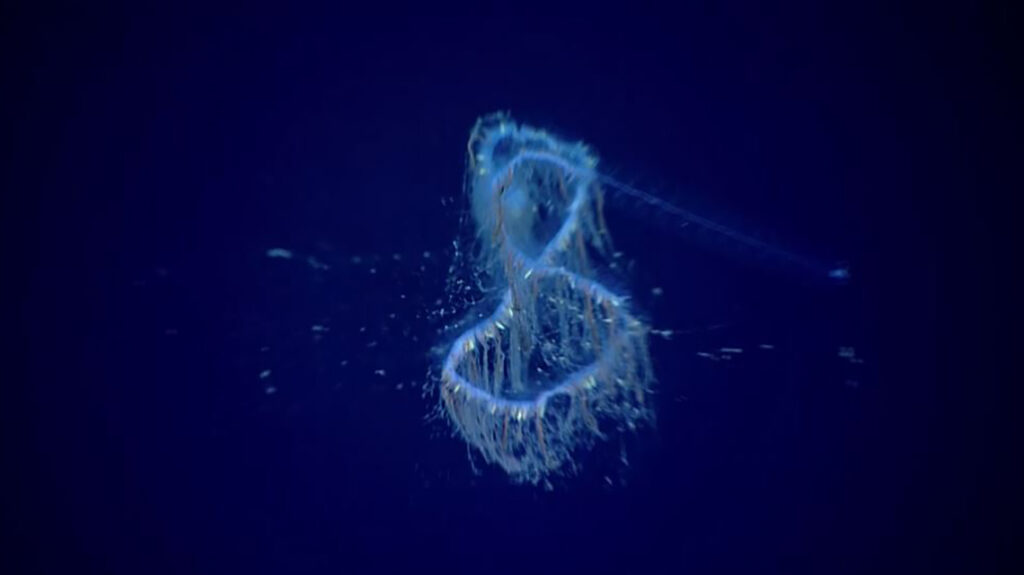
At the edge of daylight, a delicate colony drifts.
Many connected lives, moving as one.

NOAA · Musicians Seamounts, 2017Actual observation at approximately 800 m.
2,270 M / DEEP CORAL GARDENS

The reef story
doesn’t end above.

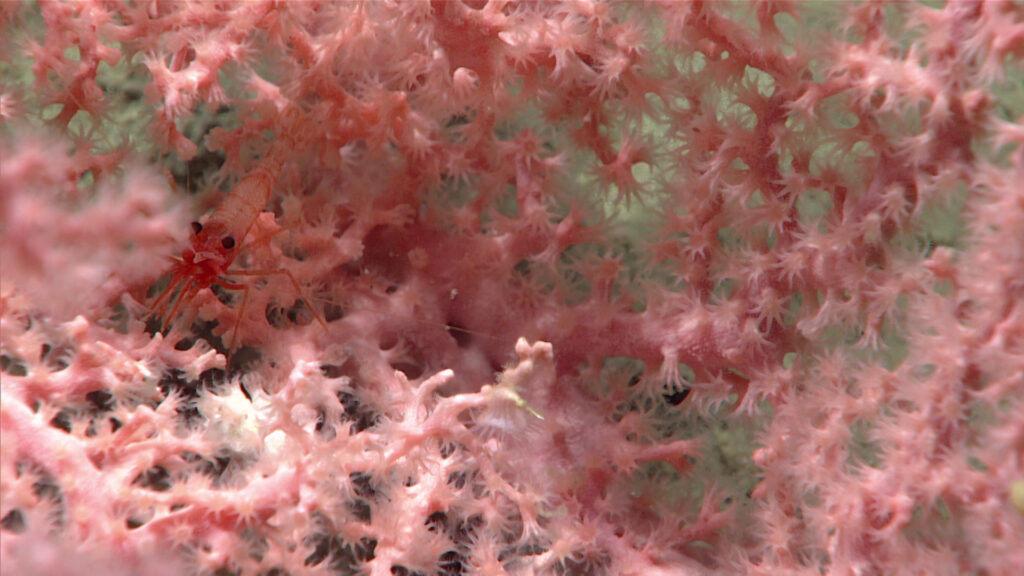
Far below sunlight, corals still make a home.
A different kind of garden. The same capacity for wonder.

NOAA · Seascape Alaska 3, 2023Real Hemicorallium coral, observed near the Aleutian Islands.
3,700 M / THE MIDNIGHT ZONE

Beyond sunlight.
Beyond ordinary.

There is no daylight here.
Yet life is delicate, intricate, and astonishing.

Real video: NOAA · Marianas, 2016Crossota at about 3,700 m. Still-image fallback: artistic interpretation.
4,960 M / THE ABYSS

Another way
to be alive.

In the darkness, chemistry becomes a source of food.
Life gathers where warm fluids emerge from Earth.

Artist’s interpretation of a vent habitatDepth inspired by Beebe vent-field observations, Cayman Trough.
8,336 M / THE HADAL ZONE

How deep
can life go?

Here, pressure is hundreds of times greater than at the surface.
Even fish have reached this extraordinary depth.

Artist’s interpretation of a trench floorThe fish record is from the Izu–Ogasawara Trench, not Challenger Deep.
≈ 10,935 M / CHALLENGER DEEP

The deepest place.
Not the end of wonder.

From sunlight to Challenger Deep.
An entire world connected by water, energy, and life.

Artist’s interpretation · depth is approximateA journey across habitats, not a single geographic dive.

You’ve reached the deepest ocean.
Keep your curiosity.

Return to the sunlight ↑Bring your discoveries together ↓
BACK FROM THE DEEP / YOUR TAKEAWAY

Less light.
No less possibility.

Life needs an energy source. Sunlight supports photosynthesis near the surface. Food can travel into darkness, and chemical reactions support food production at hydrothermal vents.

01 / EXPLAIN

Darkness changes the food story.

Compare a sunlit reef, a deep coral garden, and a vent community. Which energy routes could support each?

02 / DISTINGUISH

Looking closer is not going deeper.

Image zoom enlarges details. Depth describes a place in the water. Our plankton montage has no shared physical scale.

03 / QUESTION

A beautiful image is a starting point.

Check the observation, depth, and source. Expedition footage is evidence; generated environments are illustrations.

A NEW CASE / APPLY YOUR DISCOVERY

A coral garden at 1,400 meters.

There is no sunlight and no known nearby vent. Food particles arrive on currents. Explain how animals could live here, and name one measurement you would collect to investigate.

A hint

Separate where an animal lives from where its food was originally produced. What could currents carry?

Notes and progress disappear when this page is reloaded.

For educators & curious companions

Audience: ages 10+ with independent reading, families, and adult learners. No prerequisites. Allow 10–15 minutes, or 20 minutes with discussion.

Outcomes: explain how light and pressure change with depth; distinguish three routes that support ocean food webs; use an observation and its source to justify an explanation for deep-sea life.

Suggested path: predict in the Depth lab → compare Reef, Deep coral, and Vents → inspect a real specimen → complete the 1,400 m coral challenge. Optional discussion: “What evidence would change your explanation?”

Model boundaries: light zones are broad educational categories; real conditions vary. Pressure uses approximately 1 + depth ÷ 10 atmospheres. The food switches describe possible supply, not measured abundance or survival. This combines different habitats and locations; it is not a geographic transect.

Teaching hypothesis: changing depth and tracing food routes may help learners explain why darkness does not mean lifelessness. Learning effectiveness has not yet been tested.

THE DEPTH LAB / MAKE A PREDICTION

What powers life
when the light goes?

Predict, move the probe, then trace the possible food routes.

At 2,000 m, can sunlight power photosynthesis locally?

Choose a prediction, or explore freely below.

DEPTH20 m
PRESSURE · APPROX.3 atm

Diagram depth spacing is expanded near the surface. Arrows indicate pressure; their length is illustrative.

Try changing the food supply

These switches describe imagined supply conditions. They do not predict where vents occur or whether a particular species survives.

SunlightPhotosynthesisAvailable
Arriving particlesFood for consumersAvailable
Vent chemicalsChemosynthesisNot selected

Light can support food production here.

Model, definitions & sources

Photosynthesis uses light to make organic matter. Chemosynthesis uses energy from chemical reactions. Consumers eat organisms or organic material. The routes show possible energy supply, not measured rates, complete food webs, abundance, or survival.

This simplified model treats depths below 200 m as too dim for photosynthesis and below 1,000 m as sunless. Real thresholds vary with water conditions. Pressure ≈ 1 + depth (m) ÷ 10 atm; 1 atmosphere is approximately surface air pressure. Depth alone cannot tell you which animals live somewhere.

NOAA: light and depth ↗ · NOAA: food at vents ↗ · NOAA: pressure ↗

LOOK CLOSER

Inside a drop

Drag to explore · Pinch to zoom
1.0×

YOUR EXPEDITION NOTEBOOK

One ocean.
So many worlds.

Choose a depth to return to. Open the discoveries along the way, or slow down and magnify a world you’ve never seen before.

A connected journey across habitats.

This descent combines shallow reefs, open water, deep coral gardens, vents, and trenches from different places. It is not one geographic dive. The vertical scale gives more room to the upper ocean; scroll distance is not proportional to depth.

Depths label representative habitats or cited observations. Sunlight boundaries follow NOAA’s educational model: sunlight to about 200 m, twilight to about 1,000 m, then no sunlight. Actual light conditions vary. Pressure is approximated as 1 + depth in meters ÷ 10 atmospheres.

Motion and scale.

Slow dive scrolls the page automatically; touching, scrolling, or using navigation stops it. Ambient videos show real NOAA encounters. Other environments use gentle image motion. The drifting particles are decorative, not measured currents or organisms. Pause motion at any time.

Photography and artistic interpretation.

The whales’ environment, tropical reef, plankton montage, jellyfish environment, vent scene, and trench floor are AI-generated interpretations. They are not documentary records or exact species assemblages. Real NOAA and NASA photos and footage are individually credited. Zoomed images are digitally enlarged; organisms in the plankton montage are not shown at a common scale.

Challenger Deep’s depth is approximate: 10,935 m follows the NOAA source linked below. Measurements and estimates differ. The 8,336 m fish record is a separate observation in the Izu–Ogasawara Trench; its discovery video is a shallower example from Alaska.

Free to explore. Made to share.
Learning Frontier · An open learning studio from ACED.
Independent educational experience. No NOAA affiliation or endorsement.